Thursday, 5 November 2015

MM: Research into Horror/Thriller - Source 2 & 4

Reading Source 2

1. Why are stories that 'aim to scare their audience' so popular? - They bring out our deepest fears and characterises them. They often give you adrenaline, similarly to situations of fear. We project ourselves onto the protagonists and so we feel the same fears as the characters. It is very easily understandable and relatable as many share the same phobias. Even the simplest ideas and concepts can terrify audiences. Such as Nightmare on Elm Street (Craven, 1984) which had the premise that if you get killed in your dreams, then you get killed in real life. I think that this was scary because it takes something that everyone does and often enjoy, sleeping and having dreams, and makes you terrified to do it. This concept is timeless as it follows something that literally everyone does everyday and so it is still scary today. 
The famous and frightening hand of Freddy Kruger protruding on someone in their sleep in Nightmare on Elm Street

2. What insight can the study of horror monsters give? - They give insights into the anxieties and fears of the modern culture. Different people have different phobias, but there are more common ones, such as spiders. Many of the horror monsters created proceeding the 1930's would be representing the rulers of oppression at the time. Many of them would be foreign and alien like. This reflects the fears of others invading the country in which they lived in. 


3. What did Nosferatu (1922), one of the earliest horror films use the vampire as a metaphor for? - Since the vampire killed with penetration and the exchange of body fluids, it was considered as sexual metaphor. But it also represents an alien like person invading society. This was culturally relevant at the time of WW1.

Horror themes based on social/cultural context -
Usually when films from decades ago are remade, they aren't as effective as they don’t carry the same cultural context of the time. Here’s an example, The Ring (Verbinski, 2002) was scary as it explored the impact of the ever developing technological advances in the time. In 2002, they were advancing at a fast rate and many people didn't know of what even the intermediate future might hold and this was frightening. If this was to be remade in the current era, it would not be as culturally appropriate and so not be as terrifying. People now are quite used to new technologies much more than before.


Samara in The Ring

Many films recently such as Unfriended (Gabriadze, 2015) explore the dangers of the internet and how you can terrorise others with total anonymity. This it is considered scary as it is a very relevant issue. 
The entire film is shown through Skype conversations. Shown here is a ghost.
Other modern horror theme is sex, often unfaithfully. Movies such as Knock Knock (Roth, 2015) and It Follows (Robert Mitchell, 2014) follow the premise that bad things will happen after you have sex. The main antagonists in these movies would be trying to kill the protagonist after them having sex. In Knock Knock, the main protagonist is hunted down and they attempt to murder him after he gives into sexual intercourse with two women, although he is married. In It Follows, something similar to a curse is passed on through sex. The creature would then proceed to approach you by a slow walk. It could take the appearance of anyone. 


The creature in It Follows
Is Horror still relevant? - It is still relevant as it has the ability to adapt to tap into each generation’s preoccupations and concerns and it can be used to deal with ideas and issues that appeal to a large range of audiences. Other film genres such as Westerns don’t have the same effect and impact as horror as it is appeals to people’s primal senses of fear which is a universal language. Horror is a very vast genre and it will continue to expand and develop as society does. 


Reading Source 4


Why do audiences seek out thrills vicariously? - 
Commonly all the action is based around extraordinary events happening to ordinary people and so it’s very easy to feel the same emotions of the characters. There are three main reasons why this is so:

·         They become aware of the real danger simply by conscious thought. The areas of safety and danger are defined.

·         Exposure to the danger and the sense of fear is triggered. You are forced to go into the danger area, often away from home.

·          The hope that the fear will be conquered and they will return to safety again.

Supernatural films are often not as effective in being thrilling as others as the audience knows straight from the beginning that it is all fiction and fantasy and so they don’t feel an equal sense of fear. Thrillers with more plausible settings often thrill more as you feel as if it could happen to you.

Types of thrills:
Suspense thriller: The audience is given information that which the character in the film has not. Here’s an example: Let’s say that the audience sees someone strap a bomb to the underbelly of a car, and then some other characters sit in the car and start to drive. The suspense is you knowing that there’s a bomb and when it is going to explode. Whether or not the bomb explodes is not important, it is simply the anticipation of the action. Suspense is a key part of all thriller genres.

Action thriller: Uses action sequences to create tension. They usually feature a race against the clock, frequent violence and a clear antagonist. They combine the thrill and adrenaline of an action film with the suspense and tension of a thriller. Casino Royale (Campbell, 2006), and generally the rest of the Bond franchise, are distinct and well known action thrillers.
Casino Royale
Crime thriller: They incorporate the suspenseful aspects of a thriller with a crime film plot. They use both action and psychological aspects to build tension and suspense. The thrill in crime thrillers would be the puzzle of the crime solving along with following the antagonist for more of the film, so we sympathise with him more and so there is tension between the chase to catch the criminal who we actually care about. A good example is The Usual Suspects (Singer, 1995) in which the perpetrator of a crime is between 5 unknown individuals.
The line-up in The Usual Suspects
Film Noir: This has probably the most distinct visual style of all the sub genres. Most commonly in black and white, with very contrasty images. All the unnecessary parts of the frame would be very dark and the character would be bright, creating strong images. It uses a narrative voice and various flashbacks to explain the intricate plot.
Memento is shown in both black & white and colour. It features elements of film noir.
Psychological thriller: rather than physical strength, psychology is used to harm the protagonist. They often incorporate elements of drama and mystery. The protagonist must use their mental resources to solve the problem rather than physical. Memento (Nolan, 2000) relies solely on the mental state of the main character for the driving the plot forwards (and backwards). Aimed more towards intellectual audiences.
Guy Pierce in Memento

TK: Research into Horror/Thriller - Sources 1 & 3


Reading Source 1 -

1 - Traditionally in horror, female characters were represented as the victims, hunted down by the stalking killer, until they were saved by the conventionally masculine male hero. However in the 1970s, various political and social movements prompted directors and writers to think differently about this gender bias. The so called 'New women of horror' were repositioned from being victims, to becoming powerful and strong characters in their own rights, not just defending themselves capably from the evil of the film, but actively seeking it out and destroying it.


Marilyn Burns starring as Sally Hardesty in The Texas Chainsaw Massacre (Hooper, 1974)

2 - The Stalk and Slash subgenre can easily be summarised as something very formulaic and derivative. Almost always they are American produced and based productions, centering around a familiar plotline - a group of mixed gender teenagers travel somewhere remote, indulging in stereotypical teenage behaviour (Drinking, drugs, and sex) before being murdered one by one by an unknown killer, who is often masked. In the film's final act, only one member of the group remains, which leads to a confrontation with the killer, in which they are forced to end them, leading to the reveal of the killer's identity.


The masked, machete wielding killer Jason Voorhees from Friday the 13th (Cunningham, 1980)

3 - These films were commonly popular with audiences of young men and teenage boys, which stemmed from two key aspects of the genre - attractive female characters (even female nudity in some) and the graphic scenes of violence. So much was the demand for films like this, that directors became increasingly creative with both the killers featured as the threat, and the manners in which hoards of teenagers were killed off. 

4 - It is argued by some that these films merely exist for visceral entertainment, created to appeal to a specific demographic of thrill-seekers and nothing more. However the opposite is also argued; on some level these films are responsible for making icons of their main villains, namely Jason Voorhees of the Friday the 13th series, and Freddie Krueger from Nightmare on Elm Street (Craven, 1984). These are not only ingrained into pop culture, but also helped solidify many of these films as continual franchises, even spanning into the present day decades after the original's release. 


Freddie Krueger portrayed by actor Robert Englund

In terms of plot, it can also be seen that these are moral tales, as the killer is often punishing the group that is trespassing on their territory, or avenging a wrong that they have committed. This in itself can be linked to traditional American values of puritanism, so at the core of these films, the murderer is simply an extreme form of punishment, used against the teenagers for committing what are represented as immoral actions. 

5 - The Final Girl is a term coined by Carol J. Clover in her essay "Her Body, Himself" published in 1987, used to describe the common trope of slasher films, where there is a sole female survivor of the killings. She stated that this character is often marked out as different from the rest of the teenage cast, displaying more intelligence and quick-thinking, but also alluding to an unwillingness to take part in the same raunchy, 'immoral' activities like her friends. She is also often written in such a way that she points out how these actions are lacking in morals, and creates a binary opposition between what is considered positive and negative in the film, in a way attempting to justify the killer's actions. 


Sidney Prescott, The Final Girl of Scream (Craven, 1996)

Whilst she is marked as powerless at first for not partaking in the same activities as her friends, the final girl emerges as one of the few who are able to overcome the threat. The balance is tipped in her favour, as her friends are killed off, she turns from powerless, into powerful. This collates into the final act, in which The Final Girl kills the killer, often prompting the narrative to return to a state of equilibrium. 

In most aspects, it is seen that the shift from powerless/powerful represents a shift in feminine/masculine, encapsulated in the final act of killing the villain using phallic object, I.E. a machete, chainsaw, or shotgun, something suitably violent. The Final Girl is symbolically surrounded with masculine connotations from the film's outset, which compounds in the way in which the killer meets his final end - often with a dismemberment or decapitation, seen as a symbolic 'castration', and simultaneously a freeing from The Final Girl's perceived sexual repression thus far. Consequently, she becomes a symbol of both masculinity and femininity, as an adult living on her own terms.

Reading Source 3 - 

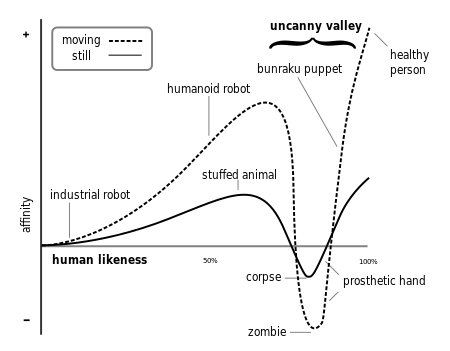
1- Research into the psychology of fear at the Open University discovered that human's tend to have a fear of things that are 'Near-human'. This phenomenon is referred to as 'Uncanny valley'.

The Uncanny Valley was discovered when researching robots, and whether giving them human like features would make them more accepted into the homes of humans, or more accepted by people who worked with them. Initially, people seemed to be more receptive to them. However, if the effect was taken too far, people became repulsed, and instead of being a form of reassurance, it became one of something sinister.


A diagram/graph outlining the emotional response to the anthropomorphism of an object

The effect explains why dolls, puppets and masks are such icons of horror, as we are naturally wired for them to instil fear in us. And so too, are zombies. The way a zombie's face reflects a human one almost - but not quite - is what makes them so disturbing and unsettling to people. The process has to do with the way the brain reads faces, and how even something small that is out of place can lead to a disruption of the visual processing, leaving a sense of unease and fear.

Often the case is that people want to lake a near-human face, however the processing mechanisms of the brain tell them something is wrong.

2 -


  • The Zombie apocalypse scenario at its core is appealing for one reason - it is survivable. Whereas a freak storm or stray asteroid will wipe humanity out without mercy, the Zombie apocalypse contrastingly is represented as something that anyone can survive by using their instincts and mind. 

The Walking Dead is an extremely successful take on the subgenre in TV, with millions of concurrent viewers
  • Other apocalypse scenarios don't offer the same imaginative prospects, as they are far more bleak views of the future, almost selective in the idea that one has to be special, or chosen to survive them. With a Zombie scenario, anyone can get through it - or at least that's how it's represented. 
  • The subgenre brings out the fantasy-infused part of the mind, allowing people to insert themselves into the narrative of an apocalypse, disregarding their reality. It appeals to the escapist portion of the brain. 
  • This doesn't take into account any long term issues raised by a Zombie Apocalypse, seemingly only the base elements are what make it attractive as an escapist power fantasy. 
  •  The violence of the event is also something appealing, to the primal part of the human mind. A key point is that "killing zombies is like killing people without the guilt". This is something that is heavily emphasised in mass media, most notably in video games such as the Call of Duty franchise in which the player can team up with friends and fire-fight zombies.


3 -


  • Zombies are often a series embedded in gore and blood, something viscerally appealing to a lot of audiences in the same way slasher films are appealing. 
  • Zombies are something that can be played with in a lot of different ways. They can be skewed to anyone's personal preferences or fantasies. 
  • Often, narratives of the Zombie subgenre centre around placing a cast of everyday characters into an apocalyptic situation, and watching how they work together, co-operate - or don't. This is most prevalent in Zombie franchises such as The Walking Dead 
  • These narratives too are often written in a way that connects us emotionally with the human characters. We are positioned with them against the zombies, and are rooting for them to survive.